
Mugolio, a dark, aromatic syrup imbued with the flavor of pine cones, is the poster child for the kind of crazy cool, Illuminati-esque foodstuff foragers have access to, all for the price of a hike, or even less, depending on how close you are to some pine trees.
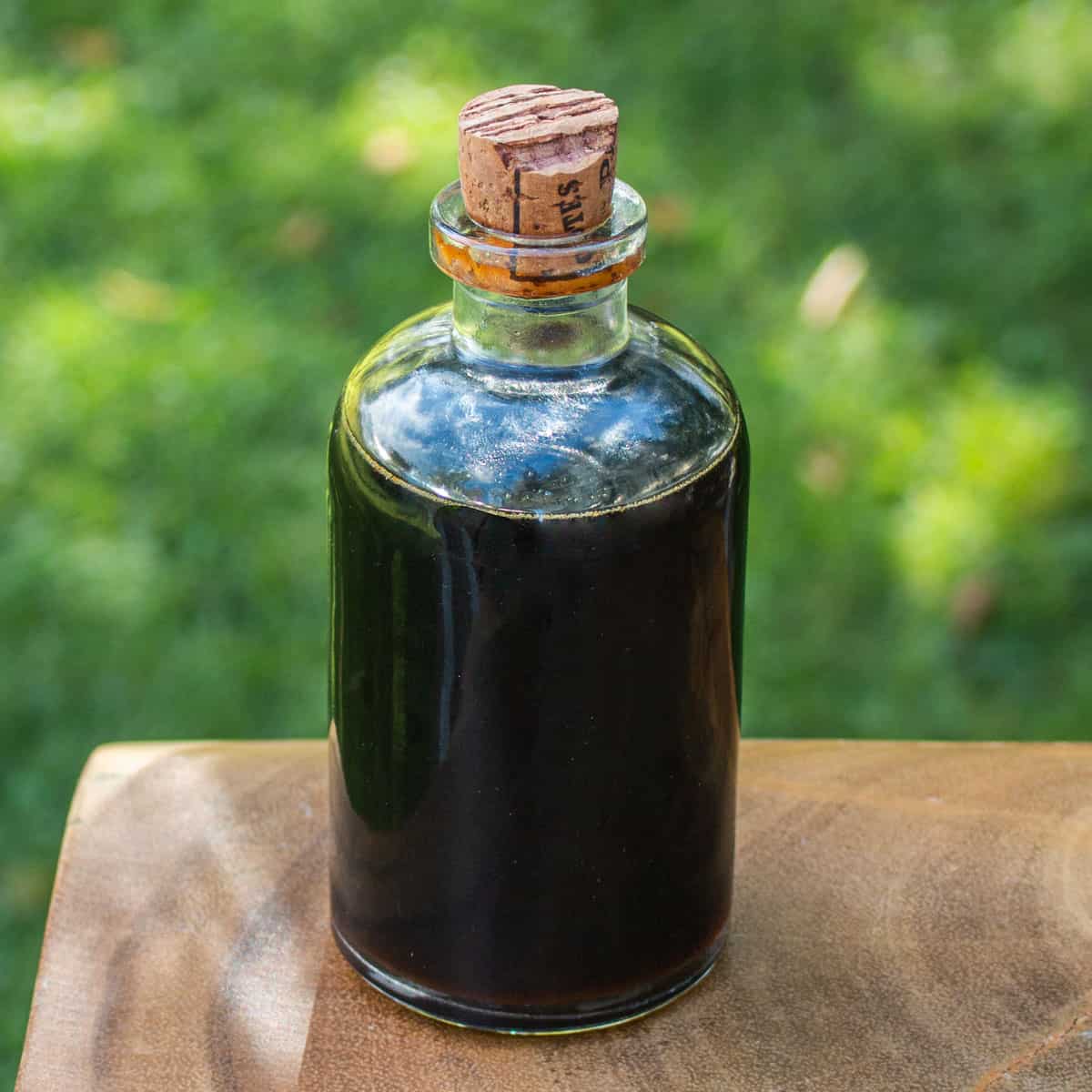
The syrup came on my radar when my friend Dan Farmer gave me a little jar of some he made to try. I remember it being good, but I forgot about it until I opened the Salt Cellar, and started making my own from spruce tips, which is excellent, but not quite the same as pine cone syrup (for the record both are great).
Mugolio is now still a bit of a chef secret, and available through elite specialty distributors, but the price is staggeringly high, exorbitant even, when you consider you can make nearly the exact same thing at home, for less than it costs to make a cake.
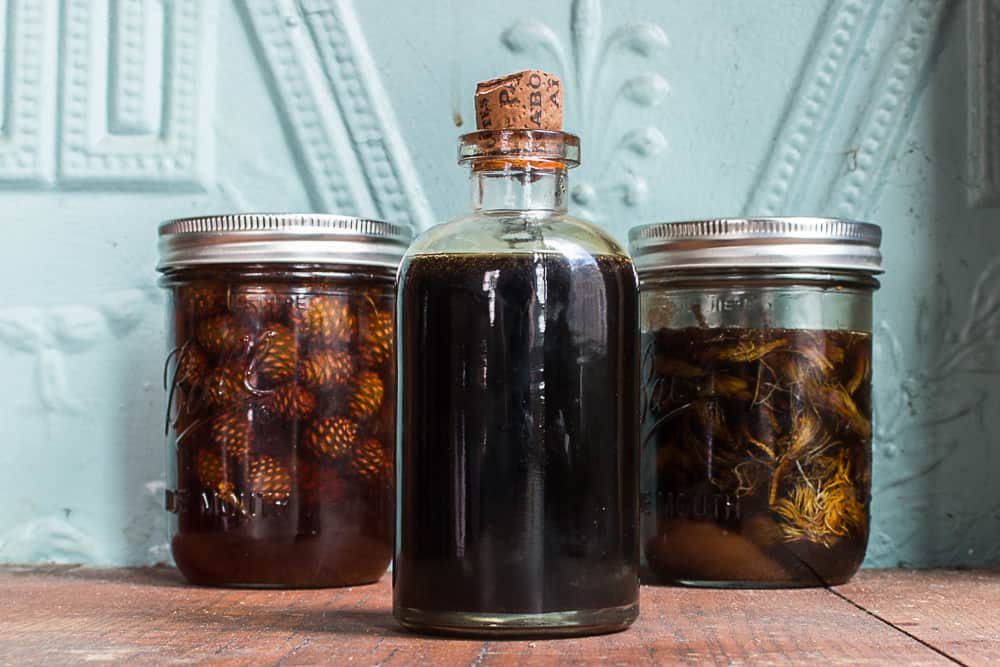
A chef secret that takes months to make
The cost of mugolio is not found in ingredients, but is paid in time. How much time is certainly up for debate, and you’ll notice my recipe turns around a lot quicker than burying a jar of pine cones and sugar in the yard and digging it up the next year (an actual recipe from Romania). You’ll want to wait at least a month for a good pine syrup, although aging it longer can be fun.
Mugolio: more than just pine cones
Real quick, some reality. I use the word mugolio interchangeably for syrups made from numerous tree parts, if you look around you’ll see mugolio usually refers to a syrup made from the young cones of mugo pine (Pinus mugo), harvested at a specific time of year, under the strictest of conditions, blah, blah, blah.
I’ve made all kinds of similar sugar based products from all kinds of conifer parts, and it isn’t some difficult, arcane thing you can only do in the light of a full moon— just the opposite.
Making mugolio is easy, and there’s a very forgiving time window for harvesting cones, or other things products like cedar cones, wintergreen, juniper, or spruce tips. All of the aforementioned making excellent syrups in their own right.
There’s something special about the pine cone syrup though. Pine cones hold more water than any other thing I’ve used, and they also ferment during the maceration process, vigorously.
The day after you combine the pine cones and sugar, there will look as if there was a rush and release of water—what was once a solid packed jar of pine cones and sugar is not 75 % full and liquid.
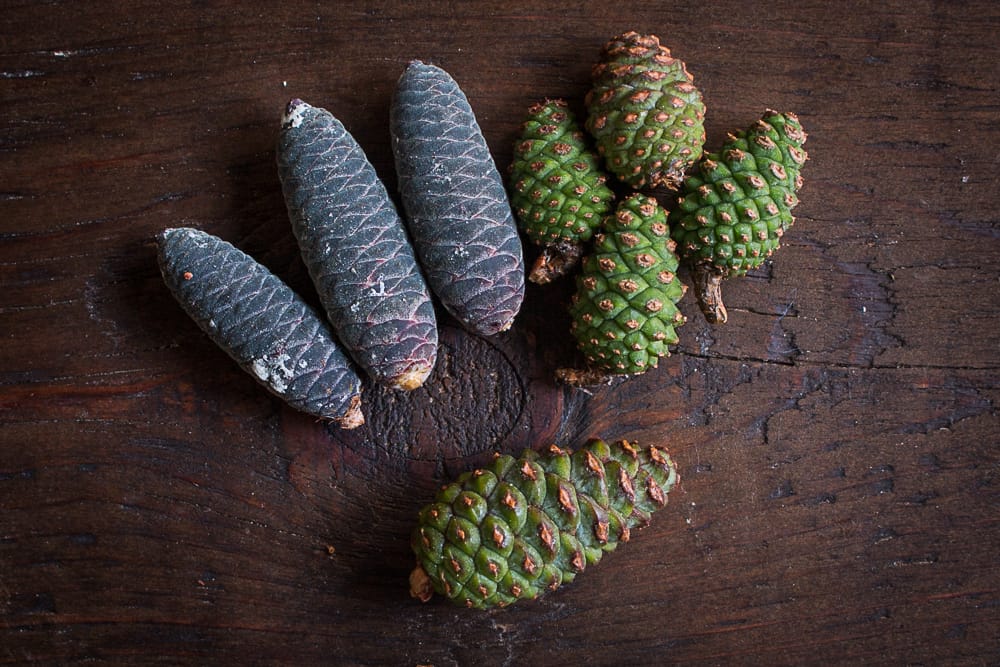
Species of unripe pine cones I've used to make syrup
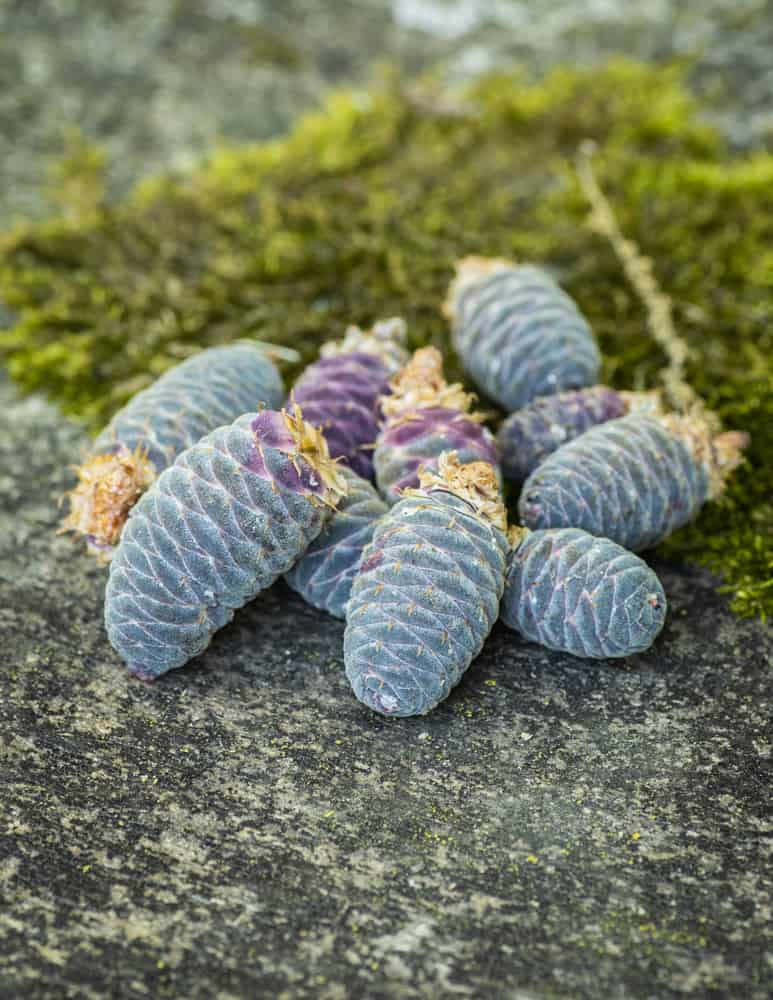
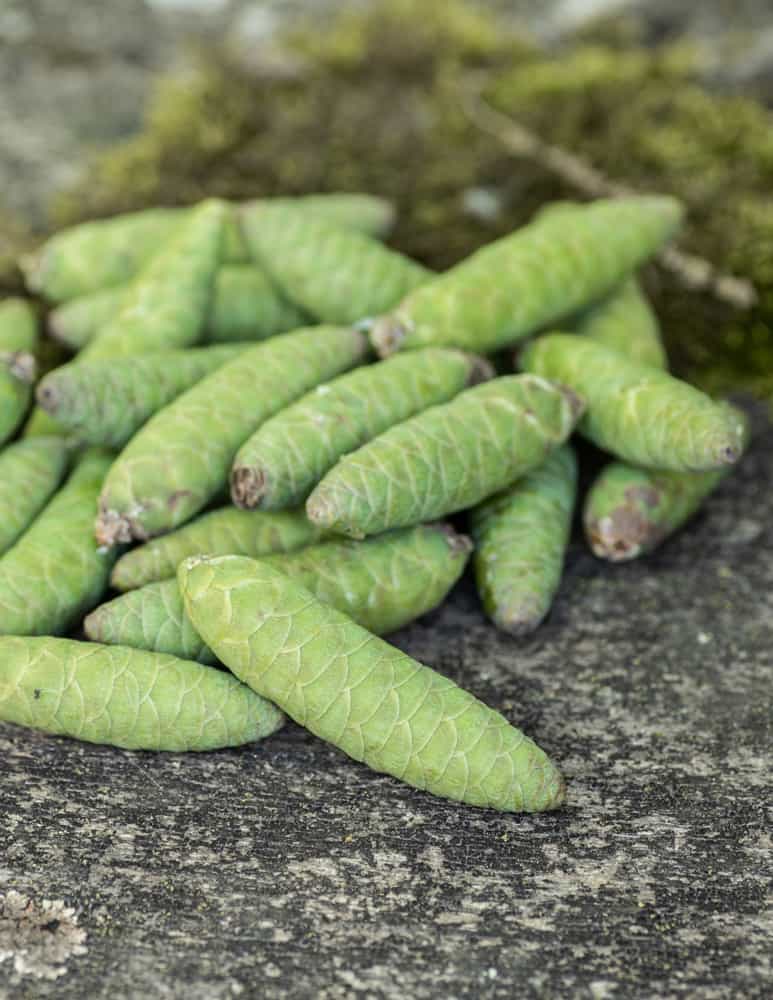
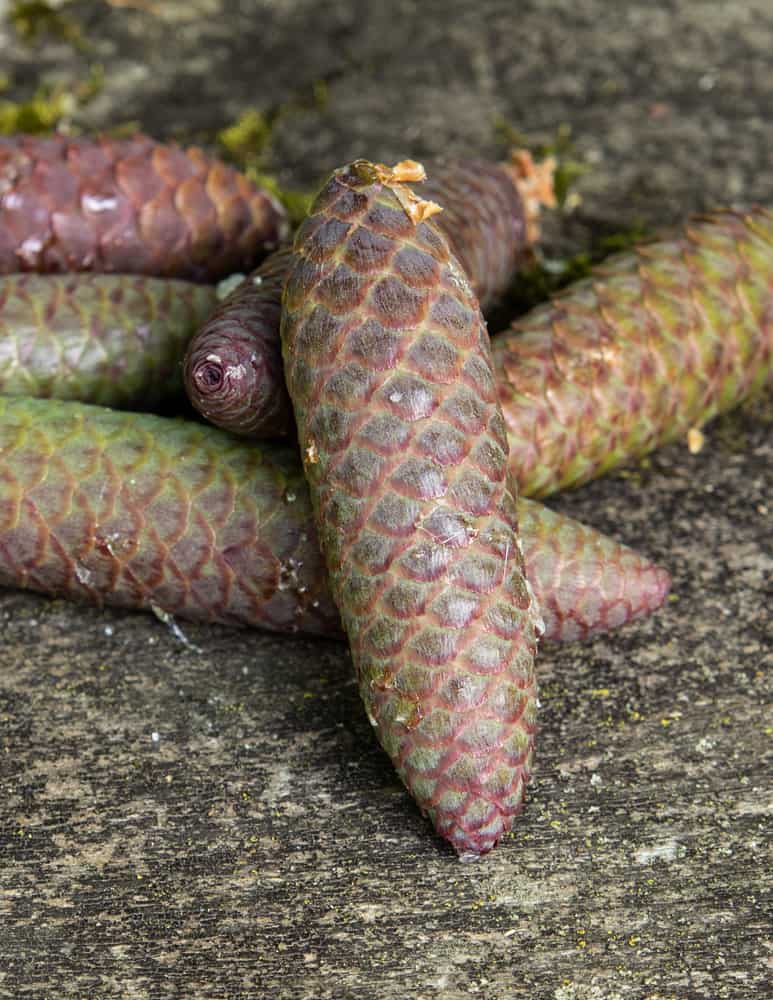
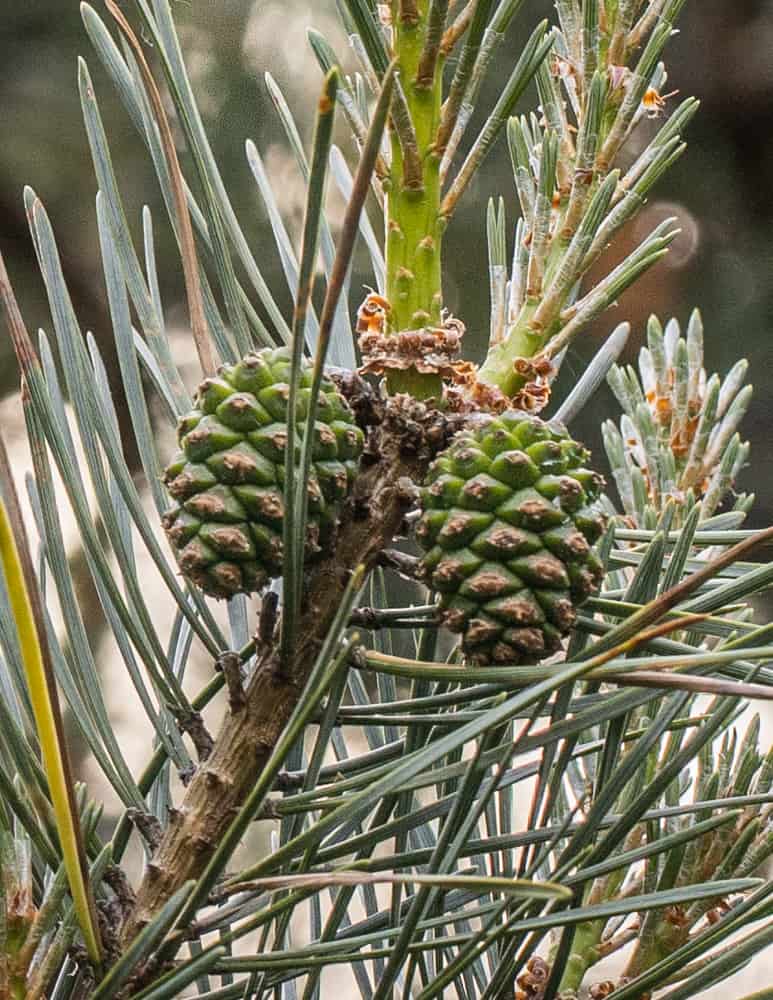
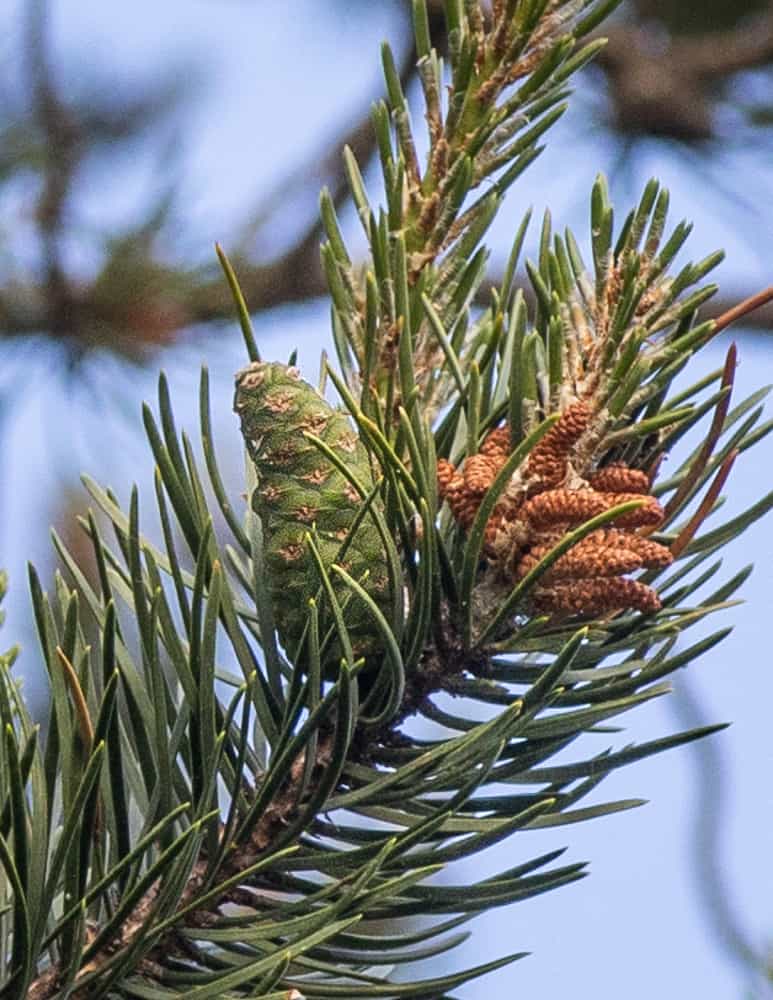
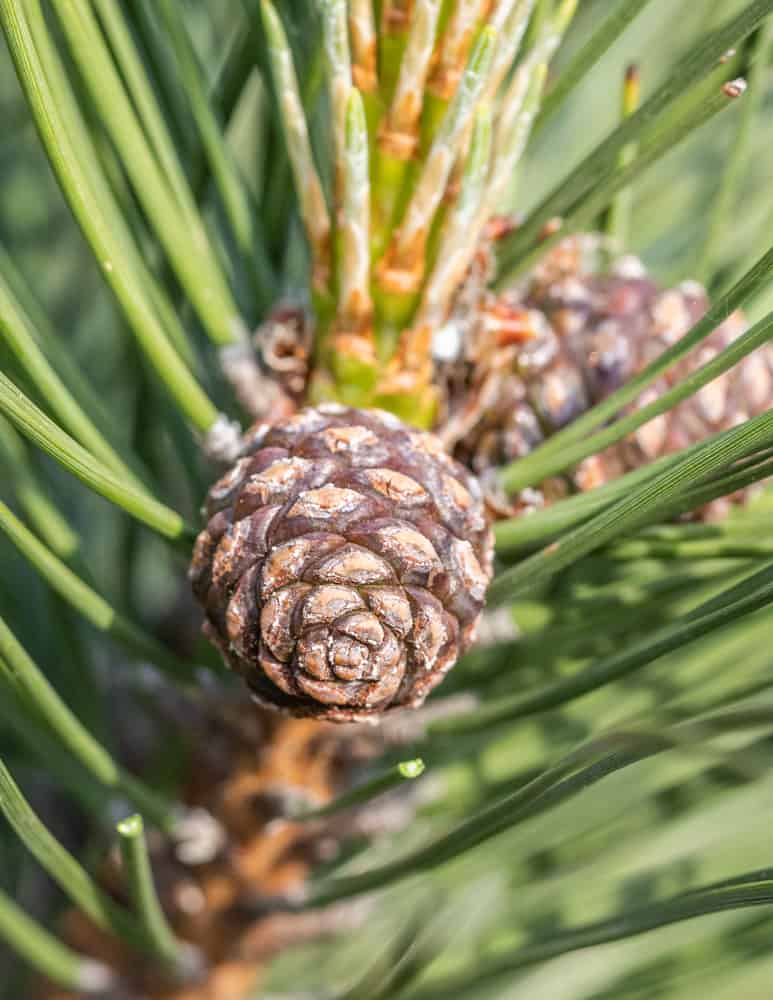
Variation in flavor between species
One of the most fascinating things about mugolio is that every species of tree you harvest unripe cones from will impart a noticeably different flavor unique to the finished product.
Once I started to notice the different flavors, I made a point out of trying to "mugolio" as many different species of unripe coniferous cone I can, and I found some fascinating things. Here's a quick breakdown of the differences between flavors I taste.
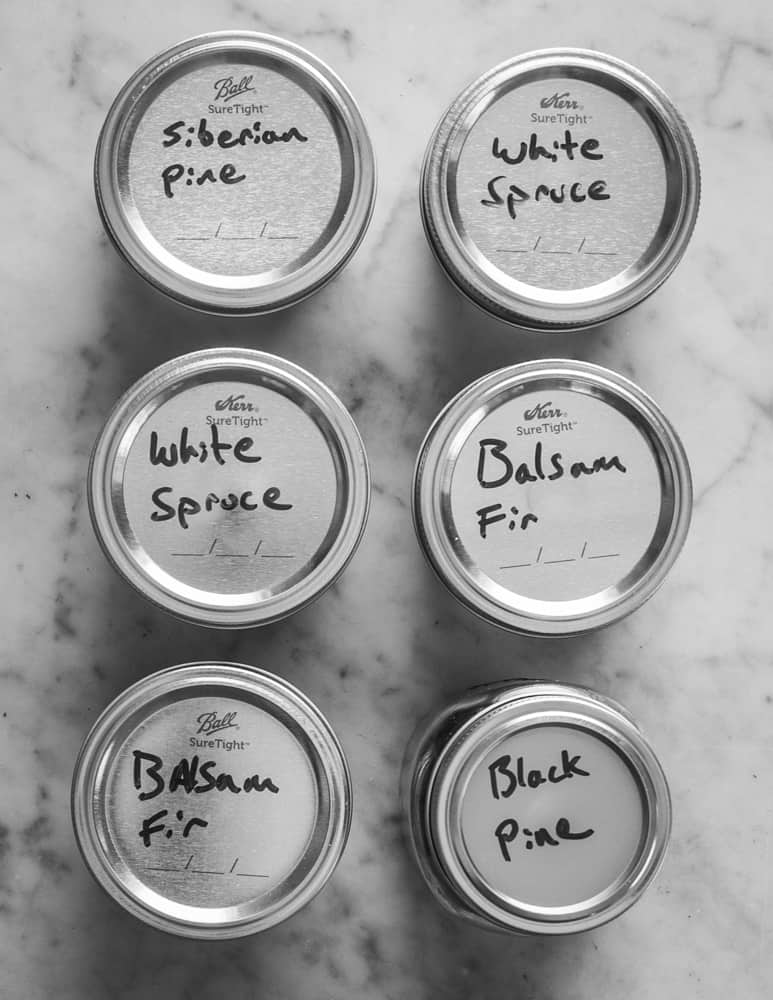
Pinus/Pines
Mugolio made from pinus cones have a resinous, assertive taste.
Picea/Spruces
Spruces lack the aggressive resinous flavor of pines and are the most subtle of all I've tasted. Instead of the resinous taste, spruce cones, just like spruce tips, have a citrusy note to them, and so will syrups made from their cones.
Thuja and likely others/Cedars
The only cedar I've made mugolio with is the green cones Thuja occidentalis, since they're easy to find in landscaping. It has a taste exactly like the aroma of fresh green cedar, a bit in between spruce and pine mugolios.
Abies/Firs
Of all the syrups here, and all the different flavors, the syrups I've made from balsam fir are the most delicious.
Firs have a resinous punch like pine mugolios, but it's slightly less aggressive, and most noticeably, comes with strong notes of warm spices like cloves, allspice, and cinnamon.
Unfortunately, mature balsam fir trees, at least around me, seem to only want to grow cones at the very top of the tree, which can make getting enough for a batch of syrup tricky.
Using other conifer products
Other tree products like spruce tips, pine tips and cedar cones I've worked with are more dry, and may not ferment during the maceration process, but they can still make a fine syrup.
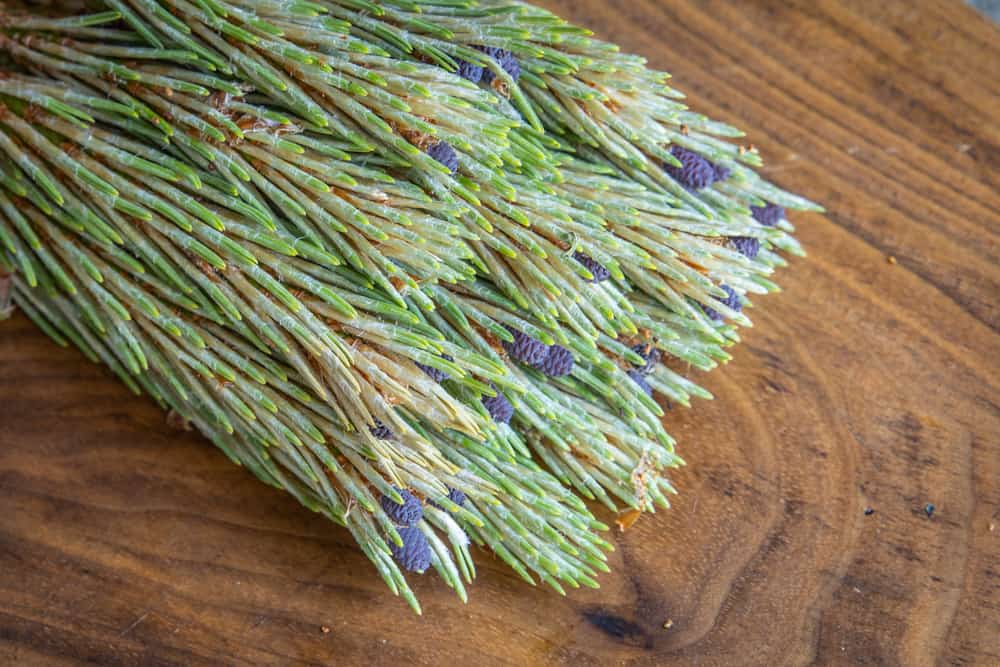
The point is: you can make syrups like this out of all kinds of things, and everyone I’ve had has been good. If you have spruce trees near you, take a look at the basic spruce tip syrup too, which is nearly the same, sans the fermentation. Here's a few things I've used:
- Unripe eastern white cedar cones (Thuja occidentalis. This could can be an abortifacient in high doses)
- Juniper berries (Juniperis virginiana)
- Spruce tips (many species)
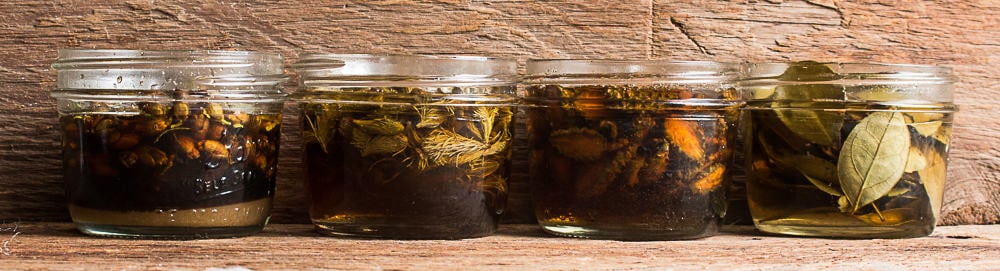
The best part is figuring out how to use it. Somethings take some experimentation, mugolio not so much.
You can literally put it on just about anything where maple syrup would be good, and you’ll be glad you did. The syrup has the essence of pine, but with none of the strong tannins you’d expect If you took a bite out of a pine cone—just pure piney goodness.
Harvest young pine cones in spring or early summer
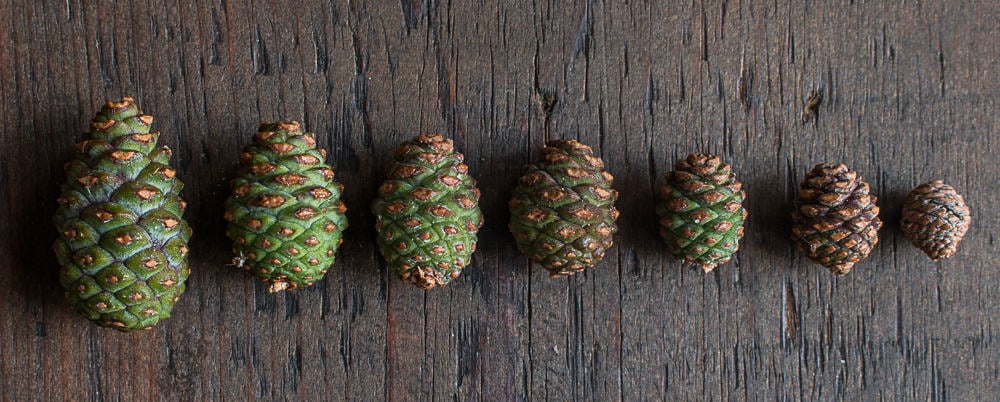
Most importantly, you are looking for unripe pine cones in the spring and early summer, not the fall, not the winter. Opened cones are not to be used.
This is up for debate, but my favorite comes from green cones as they contain more water. Purists might say that you need to harvest pine cones when they're the size of a pinky nail, or some other arbitrary size.
I can tell you after making this for years now, that any of the pine cones pictured in the image above will make a fine syrup, but smaller cones will make a syrup with a much stronger flavor, strong enough that some people may not like it.
Another good rule of thumb I've found is that whatever cone you're picking will probably be sticky and exuding resinous, sticky liquid at a prime stage for making pine cone syrup.
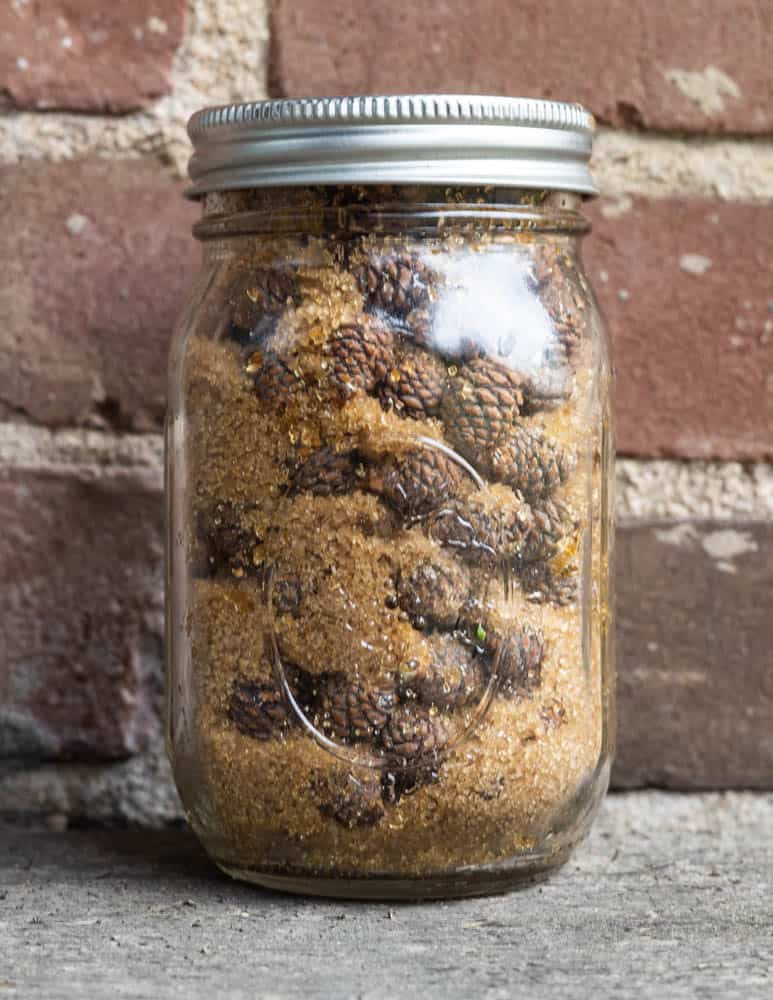
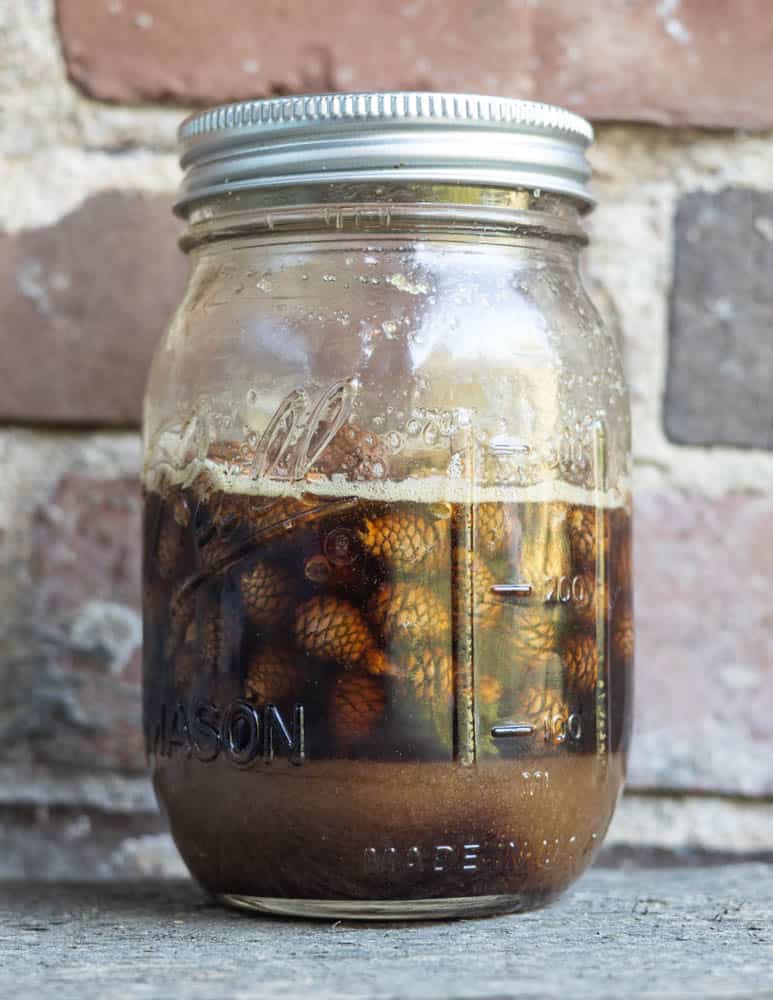
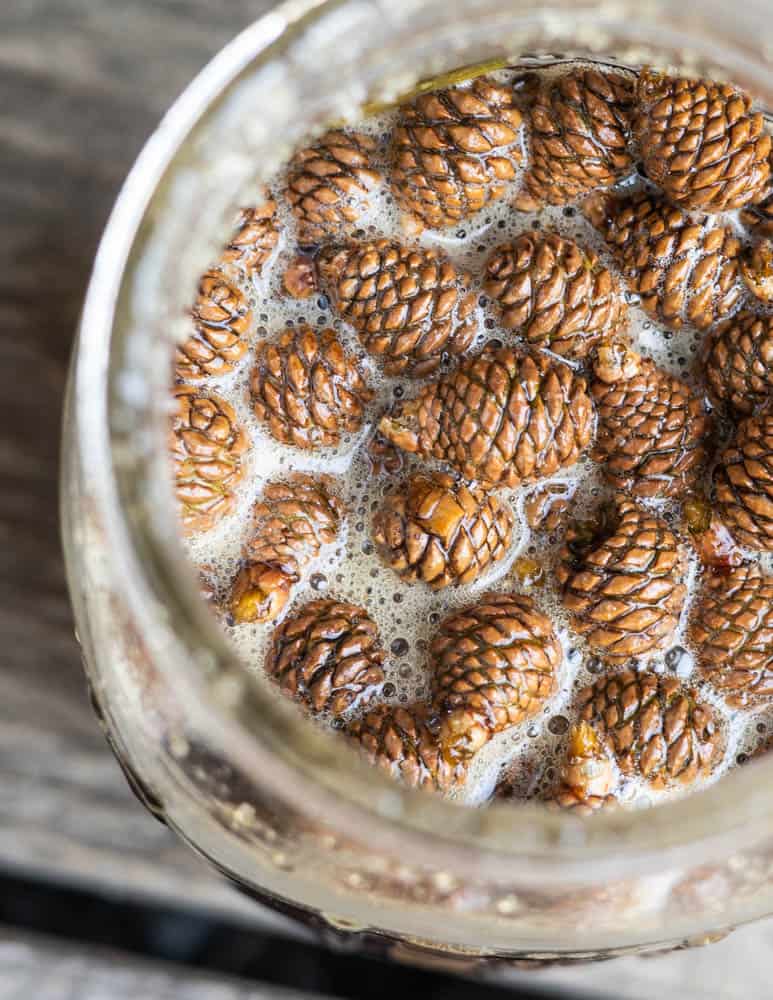
Green cone=higher water content
Larger green cones hold more water in them which makes syrup making much easier, and also allows for some fermentation in the process, which adds fun flavors.
As long as the cones are meristematic and tender, and can be cut through with a knife, even if it's into pieces with long cones like white spruce or balsam fir, they will make a good mugolio. The only cones that won't work, are mature, tough, barky cones, like those you'd see on the ground.
Using very young pine cones
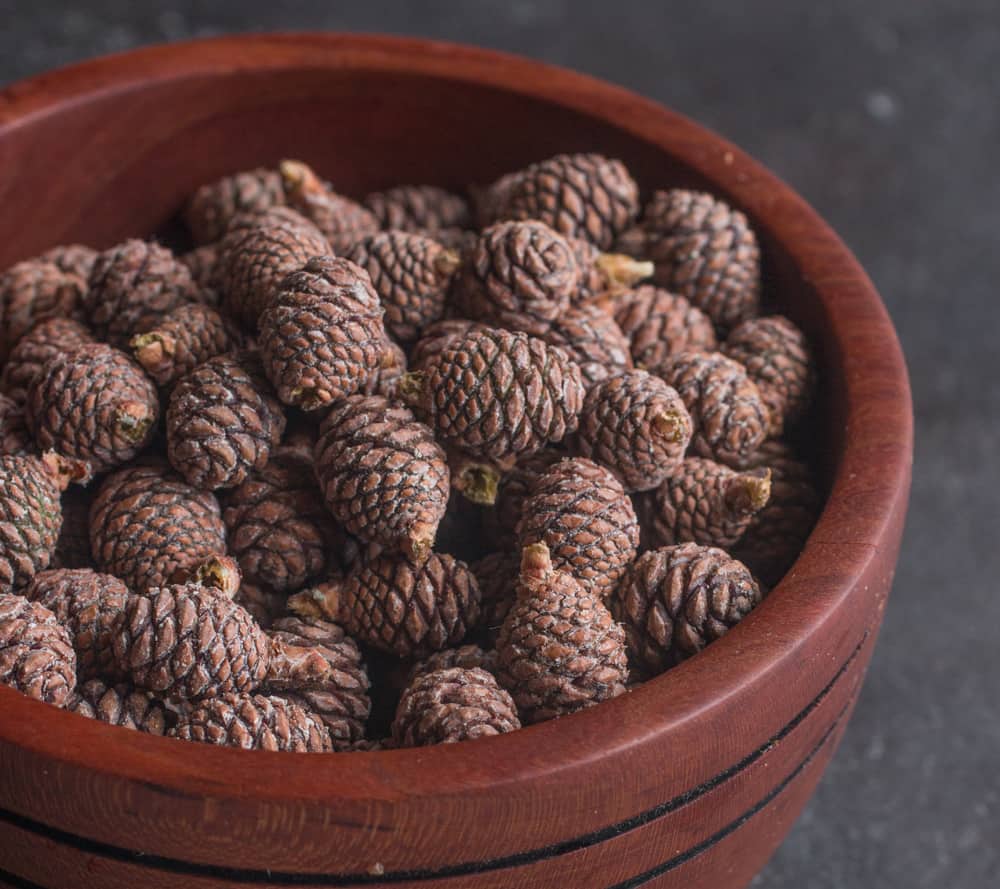
You can use young pine cones, but they're smaller and don't hold as much water as cones that are green, so they're not ideal here.
If you really want to try with very young pine cones, try chopping them up medium to make it so more cones can be fit in a jar, which means more water, meaning an easier syrup. You can also add a splash of water to help it on it's way.
Is it safe?
Yes, this is absolutely, positively safe, and there's no need to worry about botulism. I can't speak to the exact science of spruce tip and cedar cones syrups, (also safe) but pine cone syrup is especially safe as it ferments as it macerates, due to the higher water content of the cones if harvested at the green stage.
The extended fermentation lowers the pH, making it shelf stable. Remember that sugar is a preservative, and conifer products are all naturally acidic, which is a preservative in itself.
Consider using gloves
The most prime pine and spruce cones for making syrup will be plump, but still unripe. At this stage, most of them will be very sticky and oozing a sappy resinous substance that will quickly coat your hands and will stay for hours. Consider wearing gloves to avoid sticky hand syndrome.
Choosing the right sugar
Some recipes might call for white sugar, and while it will work and give you a flavored syrup, white sugar is more dry, and I find the clear color far less attractive than the caramel color that organic, unrefined turbinado-style sugar or even light brown sugar or a similar substitute will give.
I try to avoid using plain white sugar when I can, and I highly doubt that original mugolio recipes used such highly refined products when the first adventurous people crafted them.
Use a good sugar that you can feel good about eating, and drizzling over everything, because you'll want to drizzle it, on, well, everything. Here's a list of sugars that will work
Turbinado
Turbinado is slightly more dry than commercial brown sugars, but it has an excellent flavor.
Light, golden, or dark brown sugar
These are some of the most versatile and affordable, but I suggest using a high quality organic brand. The varying molasses content of the different colors of sugar is negligible in regards to the flavor of the finished syrup.
Maple sugar
Maple sugar is the most expensive you could use, and in my opinion is not the most ideal as it's prone to crystallization from my experience. It is delicious though. If you'd like to harness the flavor of maple with your pine cones, you can just toss pine cones into maple syrup at a ratio of 1 cup of pine cones to 1 lb (2 cups) of maple syrup.
Zirbenshnaps
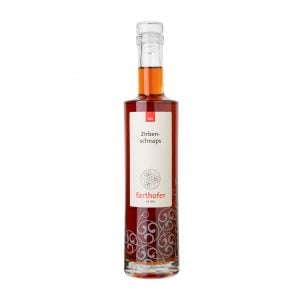
This stuff is unique enough that it needs a special mention. Zirbenschnaps is a liquor made with pine cones.
I’m not an expert on distillation by any means, but I’ve been working with a distillery to make similar products, and one thing we’ve been toying around with is making a rendition of it by simply using it as the sweetener in a macerated liquor.
The traditional zirbenshnaps has a red tone to its color, which makes me think they’re using a syrup made from fresh pine cones cooked immediately—not aged.
I know there’s also birch schnaps, and that’s made with reduced birch syrup, so I think using mugolio would be fine. Currently I know zirbenshnaps is only sold at ultra high-end restaurants in my area.
Whatever you make with it, it’s one of the most fascinating and delicious condiments made from wild ingredients I know of.
Making Large Batches
I occasionally make very large batches of syrup, 2 or 3 gallons at a time. Here's a few tips on doing that if it's something you're interested in, especially as this is such a fun (also cheap) and interesting thing to give as gifts. The tips below are intended for those people making 1 gallon batches and up at a time.
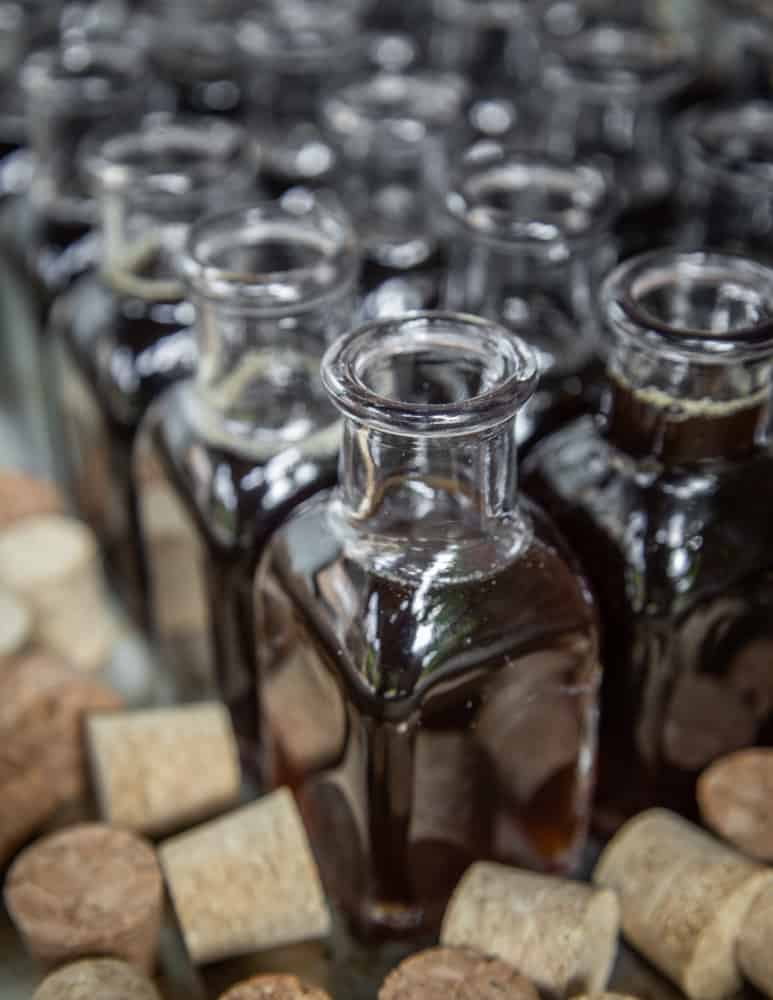
Skimming the foam
Similar to maple syrup, when you cook large quantities of the syrup, it will begin to froth and foam at the top and will double in size quickly.
Some cones seem to create more foam than others, especially Norway Spruce. When you notice foam during the cooking process, do your best to skim it off with a spoon and discard.
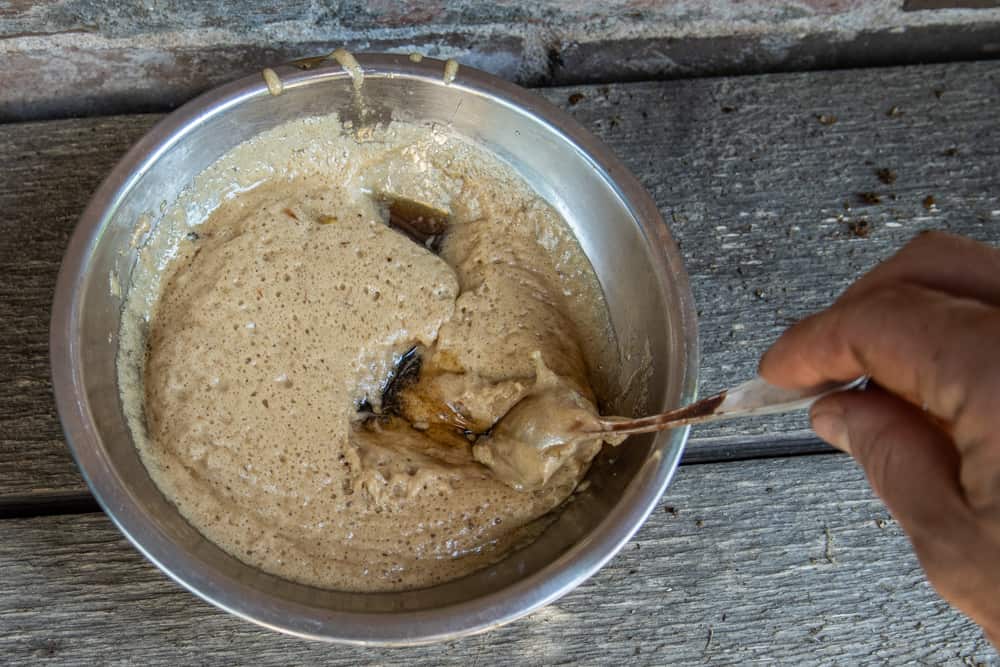
After you bring the syrup to a simmer and strain, put it back in the pot and bring it to a simmer again, let it rest for a minute or two so the syrup can settle and return to it's original volume. If you don't do this, you run the risk of having jars that are half full after settling.
Canning for long-term storage
Pour the piping hot syrup into large jars, or, for smaller ones, pour the syrup into a pitcher with a spout, and pour directly into canning jars (4 oz mason jars make a great gift). Fill the jars nearly to the brim, leaving about ⅛ inch headspace, then, working quickly, screw on the lids tight and turn the jars upside down.
You don't have to water bath-process this as it's basically the same sugar concentration as maple syrup, just make sure your jars are clean. The jars will seal naturally but should be refrigerated after opening.
Here’s a few ideas for using it, and a few things yet on my list to try.
Ideas for using
- Drizzled on pancakes, crepes waffles and other things primed for syrup.
- Use it to flavor whipped cream
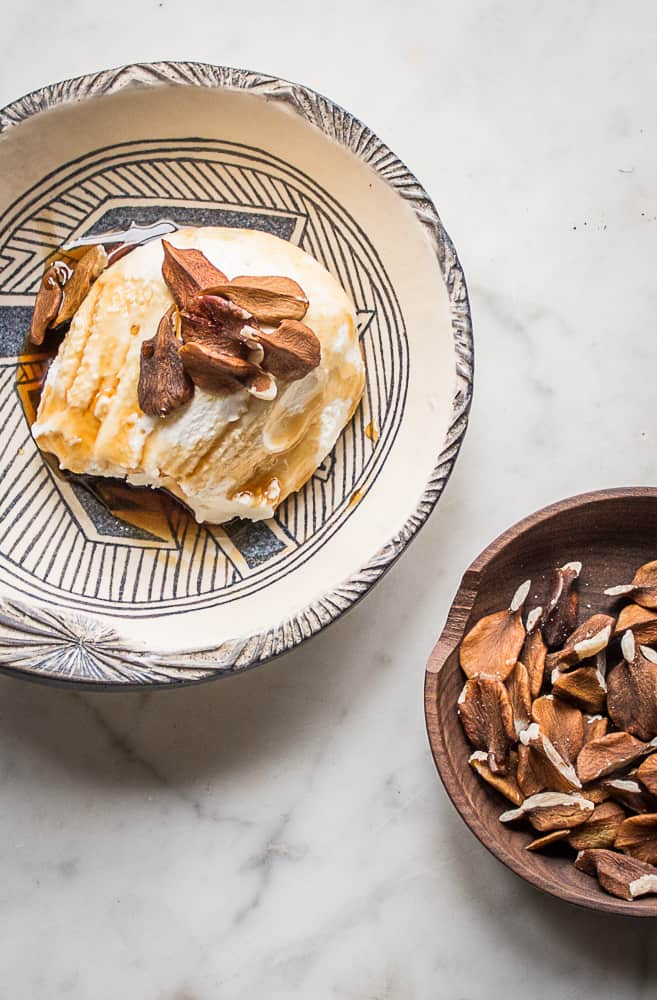
- Excellent drizzled over soft cheese like mascarpone, labneh, chevre, etc.
- Drizzled over fresh fruit
- Using in place of honey, I love drizzling it over bowls of warm buttered wild rice with nuts, fruit, and yogurt for breakfast.
- It’s good in desserts, added in small amounts like you would use honey. Dairy based desserts like ice cream, panna cotta and custards of all kinds can just be seasoned to taste with it.
- Try adding small drizzles to salads, or whisking into vinaigrettes.
- Mixing it with a splash of vinegar just to loosen it a bit makes a good brush on or glaze for hams, etc.
- One of my friends adds it to whiskey
Mugolio, or Pine Cone Syrup
Equipment
- 1 quart mason jar or similar
Ingredients
- 2 cups (8 oz) young red pine or other pine cones (soft enough to be cut with a knife) *
- 2 cups (16 oz) organic brown sugar or other brown sugar, just not white which is dry and makes a clear syrup
Instructions
Maceration
- Rinse the cones in warm water to remove any foreign particles if needed. I don't usually wash them. Inspect your cones for any that have holes or insects and discard.
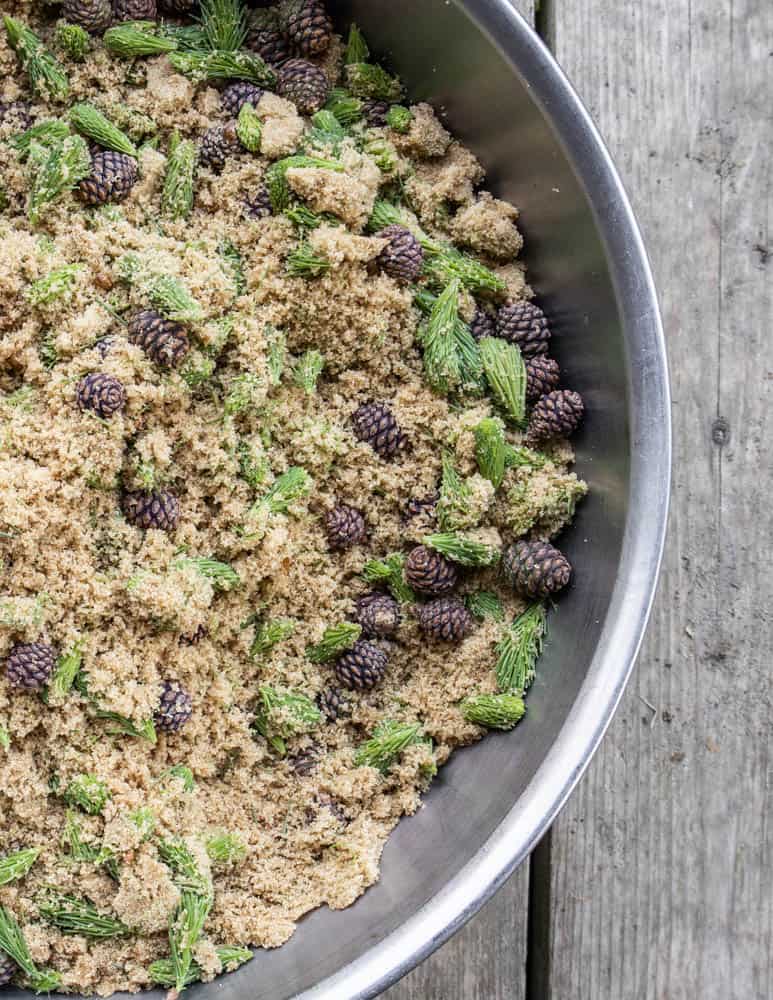
- Combine the sugar and pine cones and pack into a quart jar, then allow to macerate (age) for 30 days. Put the jars in a sunny place where they will get warm during the day, which will help ward off mold.
- During the first few weeks of maceration, open the jar occasionally to release carbon dioxide as the mixture will ferment vigorously. Shake it occasionally to help it on it's journey.
- As the cones release their water, the volume of the contents in the jar will decrease. Sugar slush will settle on the bottom and is natural. If you have more cones and sugar, you can add it to fill up the jar. The less air in the jar, the lower the chance of mold.
Finishing and storing
- After the maceration is complete, scrape the sugar slush and pine cones into a pot and add two tablespoons of water for each quart jar. Bring to a brisk simmer and heat through to melt the sugar, then strain and bottle. Discard the cooked cones and thank them for their service.
- All you need to do is bring the temperature up and melt the sugar, if you reduce the syrup too much it will crystalize after it cools. For the amounts listed it should take about 5-10 minutes.
- The syrup is stable at room temperature since the fermentation lowers the pH, but will keep the best flavor in the fridge. It can also be water bath processed, which I'll do if I sell it. For home storage I pour the very hot syrup into jars, screw on the lids and turn them upside down to seal.
Tom Dull
Alan, I have been waiting for a few months now to try this recipe. I am a Christmas tree grower and we always pick off the fir cones and throw them on the ground to enhance the beauty of the tree. The cones are about an inch long right now and we will be picking them off before long. This year I will be throwing them into a 5 gallon bucket (or buckets) and making some syrup. If it turns out, I will bottle it and sell it in my retail store on the farm. We have acres of Canaan Fir and a few Korean Fir that are very prolific cone producers. Any specific advice for making extra large batches? Thank you for taking the time to answer all these posts! Yes, I read them all. For your readers who need a source of cones, have them contact their local Christmas tree farm. We love helpers to de-cone the fir trees.
Alan Bergo
The only advice I have is to use food-safe containers like Cambro brand. Scaling it is easy, just multiply. It's easy as all you do is use double the weight of cones in sugar.
Kassidee
I love this suggestion! Thank you.
Jill
Anyone try this with a scots pine? How did it turn out? I'm excited to find out about this - I'd never heard of it before, and had always thought that some pine trees were poisonous. Thank you for sharing this information!!
Alan Bergo
Those should work. Every pinus I’ve had so far has been great. The only one that didn’t work as it was too dry was Arizona cypress.
Jill
Thank you again!!
Sinclair
Yes. I am doing it with Scots right now (still in week one of maceration). They’re excellent with a high water content, but they get VERY fizzy in the fermentation process so definitely burp daily at least in the beginning. My first whiff after opening during initial week almost knocked me out!
Maya
Double checking, are Ponderosa Pines safe for this? I know there are concerns with ingesting their needles.
Alan Bergo
I have only heard of one tree that made a syrup that wasn't that tasty (Sub-alpine fir). All of them should be safe though.
Elisa
I tried this out and it made a fantastic tasting syrup. Not sure where I went wrong though as the bottom half crystallized once bottled. Womp womp.
Alan Bergo
You cooked it too long. This can happen especially with small batches that will be more finicky, but, if I have people start out making large batches, they will have way more syrup than is practical for home use. Warm it up to loosen it and add a splash of water.
Becca
Unfortunately I found this at the wrong time of year! Hopefully I can remember to look for cones next spring/summer!
But I was curious about contaminants- is there anything you do to clean the cones of dirt and debris and check for things like bird poo?
Alan Bergo
Yes, don't pick cones with bird poo on them. 🙂
Sinclair
I live in the city and feel compelled to try to “clean” off pollutants and less savory critters before I jar things up. I do a brief bath in a bowl of cool water with a splash of hydrogen peroxide. Let sit. Stir a few times, Then I rinse and they’re ready to jar. Not sure how good this is for the cones considering in its pure form H2O2 is a cell destroyer, but diluting it so much in water hopefully just helps get some of the ick off the cones before the long jarring process. Probably just helps ease my own neuroses more than anything else.
Alan Bergo
That'll work fine.
Teri
If using juniper, I assume ripe berries/cones??
Alan Bergo
No I would use green, remember part of the process that is important here is for the coniferous object in question to have a high amount of natural water. Ripe cones will not.
Connor
I am in middle Tennessee and I cant find many trees for this. I have found some of the spruce trees with long green cones. The only issue is the green cones are maybe 30 feet in the air. Not sure how to harvest cones when they're all so high. Also what time of year are most cones going to be green?
Alan Bergo
The cones MUST be harvested in the spring or early summer, or it wont work.
Sinclair
I will say that this year in Seattle, our Doug Fir cones are still green and oozing sticky goodness, so I’ve picked them even this week (Aug 15) to make additional batches. Not sure if this is an unusual year, but they still seem young and even small on some trees in our parks. We are in the northernmost part of the state, so perhaps there is a geographical reason for these cones still being so fresh.
By the way, I really appreciate this comment section and how quickly Alan gets back to our questions. It makes this project so much more fun and I can’t wait to do more of the chef’s recipes! Thank you, everyone!
Alan Bergo
Glad it's been helpful for you.
Jeremy
This looks like so much fun to get into. I looked into this too late in the season. Would it work to make this with a sugar substitute like stevia or erythrol? Or would that mess up or be potentially unsafe for the process?
Alan Bergo
Thanks Jeremy, for safety especially, this should only be done with good quality, real sugar.
Jeremy
Okay sounds great thanks for the quick response!
Avalon
If using lemon for flavor how much and when would you add it?
Alan Bergo
I don’t add lemon to this. If I was going to, I’d add it off the heat after I simmer it, as cooking citrus can add bitter notes and weaken its aroma.
Caterina
Hi Alan! So first of all thank you for the recipe and work! I live in Mexico and found some young black pine cones last week. I started yesterday and was wondering how often should I be opening the jars to release the CO2? This is the first time I try a recipe like this. I'm also keeping it inside a wine fridge which is at 15° Celsius, is that okay? Room temperature here is pretty warm!
Thank you so much!
Alan Bergo
Your temperature is fine. The co2 from the fermentation process will never be enough to break a jar, so don't worry about that. You should stir it once in a while though.
Mike
First of all wanna say thank you Alan for the recipe and inspiration.
I'm using young green pine cones picked locally, coming up on the 1 month mark. I may have misjudged the proportions of ingredients and right now my macerated mixture looks like a 80/20 ratio of sugar to liquid.
Should I supplement the mixture with a bit more water, leave it alone, or compensate with more water during the final boiling step?
Alan Bergo
Leave it as-is. It's fine. A month ago would have been a little past-prime to harvest green pine cones, you really need to do it in the spring for them to have the most aroma. I would go ahead and bring it to a simmer, strain and taste it-the sugar will melt. If it firms up in the fridge warm it and add a bit of water to adjust the consistency.
Sunshine Fox
You mentioned making this with Juniper berries…should they be green like the pine cones or should I wait for them to mature?
And have you ever tried making this with pine catkins? (Or are catkins the young cones?)
Floris
Thank jou for the recipe in advance.. I livenin the Netherlands and used pinecones, green and 2 to 3 inch in size.. Tree is Pinus Sylvestris.. The lines are young and green.. But not soft AT ALL.. Does that matter or just takes more time? Thank you in advance
Alan Bergo
They need to be soft enough to cut. I have noticed some cones stay a little green when they are getting firm. I would set a reminder to get some in the spring.
floris
Thanks .. Will do.. Will try with heating and see what happens.. Maybe will end up with a syrop of sorts.. 🙂 just discarding them feels like wasting everything.. Thx again.. And will set an alarm..
Sabine
I live in southern Australia and radiate pine is the pine that is prolific in the area- I’m wondering if i can use the flowering tips of this pine tree? And would the pine to sugar ration change?
Alan Bergo
Those will work. Cut the pine tips (again they must be young and tender) into pieces, then use the same weight of sugar as the original template/recipe. If, after 5 days the tips are not covered in liquid, add more sugar and a splash of water until they’re covered. Make sure to stir once in a while.
Sabibe
Thankyou Alan -I’m starting my journey tomorrow - cant wait to taste the syrup. Thankyou again.
Alan Bergo
Let me know how it turns out for you. If you have any questions, don't hesitate to shoot a message over.
Mirja
Just opened a jar of mugo that I've let age for 3.5 months. Amazing. Started with about 2 cups of very young red pine cones and 2ish cups of sugar. My yield is 8oz. Time to figure out what to use it for.
Alan Bergo
Glad it worked for you Mirja.
dabney
I would think by now that you would be at a level of professionalism where you didn't need all these insanely annoying ads (what they really say is i'm cheap and greedy) It sucks, trying to read a serious article with visual bombs going off in your face and i've started to go elsewhere. Just sayin'.
Alan Bergo
Dabney, I hear you. I said I would never put ads on this site, so let me tell you why I did. I started this site while I was a broke line cook, living in my friends basement. At that time, with little traffic and a non-existent mailing list, it was pretty cheap to run. Even so, there were costs, mostly food and ingredients.
As time went on, the costs associated with the website grew proportionate to the readership. For 8 years I absorbed the costs, and didn't think twice about it. Everytime someone sent me a message that I had helped them learn something new, or helped trouble shoot an issue was payment enough. Little by little, the costs started to add up though. Here's a list of companies I have to pay every month to keep my feeds alive. Some are a few bucks a month, others are in the multiple hundreds. All of them to provide a service of sharing information that brings me exactly ZERO income.
Mailchimp
Linktree
Wordpress.com
Hosting company
Various plugin memberships
Lightroom and Adobe
Journalistic article memberships
Facebook
Instagram
These are only online memberships and similar, too. The foodcost for recipe development for the site alone (I'm about 20k in the hole from writing my book, which is separate) is about 6-800/month at this point. OH, and don't forget the gas it takes to travel to all kinds of locations I visit, and the thousands of dollars in legal fees I spent last year filming a show my videographer and I shared for free on here, as well as the thousands of dollars I sunk into FB to try and get it enough views to show the powers that be that wild food has a legitimate audience.
Fast forward to 2020. When covid hit, the views on this site increased dramatically, into the multiple millions. On one day, when 20,000 people visited a single post featured on a (semi) mainstream online news outlet, my hosting company saw it as a red flag, and pulled my entire site offline without warning. The host company held the site hostage essentially, and gave me two choices-return the site to a back-up that was 4 months old, losing months of work in the process, or pay a couple thousand dollars immediately and install a dedicated server to handle the increase in traffic. Having just lost all my speaking gigs and consulting income overnight, my options were grim. I could not afford to support the site out of my own pocket anymore.
One option was to simply say goodbye and remove the site from the net-not my favorite. Another would be to put all the information behind a paywall-also not my favorite. Or, I could start some sort of Patreon, and try to add on another online platform and the learning curve that goes with it. Lastly, I could install ads. The ads barely bring in enough to keep the site in the black, but they make it so I don't have to pay to give out free information anymore. Ask yourself, what would you do?
What the ads do, what they truly do, is make it so everything I have put into this site: all the money, research, thousands of images, and time can remain free to anyone, anywhere, keeping it free, just like the wild food I represent. To insinuate that I actually make money off of it is silly, but understandable, as, unless you run and maintain a site yourself, you would never know the sort of pennies an ad company brings in unless you're a site like the NY Times, etc.
If you haven't done anything similar to what I do yourself, or, more specifically, had to weigh the difficult ethical and financial decisions I've had to make, I won't be taking any criticism from you. For some people, free apparently isn't cheap enough, and I'm happy to see you go.
Alan
Eric
This is the single greatest thing I have ever read on the internet.
Alan Bergo
Thanks Eric, I appreciate that. Lots of work.
MiTmite9
Alan: Thank you for teaching me about mugolio. Found the link to your site via Reddit ---- on a discussion about Araucaria bidwillii. Someday I will have to try making pine cone syrup.
Alan Bergo
Thanks MiTmite
MiTmite9
Eric. i agree. Learned more than I bargained for ----- about cost of running a FREE info site. Elucidating.
Sinclair
Seriously appreciate this response. Easy peasy, folks!
Alan Bergo
Thanks
Toni
I don’t think I could possibly convey how excited I am to try this! My son and I found a perfect place to forage for some cones, with many different types of trees (many of them reachable by this little short lady) - so I am planning on trying a few different ones. One of the trees we have abundantly in my area is larch. I have read through this a number of times but haven’t caught a mention of those. Can I use larch cones for this?
And I wanted to thank you for this recipe and the Pine Cone Jam recipe. I have been wanting to sharpen my rudimentary tree identification skills, but couldn’t get sufficiently motivated to do so. I stumbled across these two recipes and BAM! - my passion was ignited. So thank you! I have spent much of my half century outdoors, but only started wild foraging recently with my adult son. This has become a wonderful hobby which I greatly enjoy - fueled in part by people like yourself who share your knowledge. You have my sincere gratitude.
Alan Bergo
Thanks Toni. As far as I know right now, the only cones people haven't cared for are sub alpine fir.
Frank Magner
Alan, success requires no explanation and failure permits no alibi. Keep doing what you’re doing and disregard the noise of those who have never walked in your shoes. You are doing great work so, go forth and do more great things!
Alan Bergo
Thanks Frank.
P1cklebaron
Alan, I just want to thank you for all that share to the masses online. I tried a similar recipe last year but I did it all wrong. Then I found you and your post, a huge leap ahead of the Instagram version I tried last year. Like you, it’s a passion of mine to find the old recipes, the odd ingredients and be self reliant enough to make something of it. Keyboard warriors like dabney don’t get it. They haven’t put the time in, they haven’t had the life experience to understand nothing comes for free. I’ve been in the hospitality industry for over 25yrs now and lived a kitchen confidential life while finding my way through it all, it’s people like yourself that give to other selflessly and feed the passion for the next generation of culinary wizards. Dabney is a blip on the scale of life here and gone but with no real effect other than to annoy. Please keep sharing for the rest of us loyal and newly inspired followers.
Alan Bergo
Hey thank you. Lots of work goes into what I do here.
Dorothy
Bu-bye. Ur rudness is uncalled for n show u have a bit of ugliness in ur soul.
Frank Magner
Oh, you must be one who thinks only one opinion (yours) matters. Don’t get your feelings hurt when someone else may disagree with what you think. Learn from that! It’s something called critical thinking. Get with the program!
Kris
So I didn't see anything about doing this with local raw honey? I realize it would crystalize, But I'm used to melting down honey or even using in solid form. I also realize the honey would add another flavor, but I have some mild wildflower honey I suspect would be very yummy.
I'm trying to stay away from cane sugar.
Love the fact it's not just infused with pine but actually fermented.
Also, since this is lacto fermented, does it have all that amazing gut bacteria found in many fermented foods? This would be a really great way to get in more pre and pro biotics!
I'm thinking this could be more healthy than using raw honey!
Alan Bergo
You can do it with raw honey. I have a section on that in my post on spruce syrup. Since you heat the syrup after the maceration it will kill off bacteria, good and bad though.
Chris
I have about 8 mugo dwarf pines all around my yard. I imagine these are safe to use and are the same as the mugo pines they use in Italy? Any idea?
Alan Bergo
Yes. Pinus mugo. Same tree as the Italians use. I’d be interested in tasting some of the syrup if you make a bunch. I could send you some really fun ones I’ve made. Lmk.
Sarah Bliss
I’ve been a fan for years. Thanks so much for sharing your vast knowledge and contagious passion!
You’ve written that all true conifers are edible. I just want to doublecheck that cedar berries will be safe. And if so, have you tried this with them? Tasty?
Alan Bergo
Thanks Sarah. Cedar cones (Thuja occidentalis) are fine and I've made it with them, the berries that resemble juniper should be ok too, as this doesn't absorb tannins and astringency-I haven't made it with them specifically though so it's just an educated hunch. Either way it would be safe.
Sarah Bliss
Thanks very much Alan. I'll proceed, and try to remember to post back here about my results after the long fermentation. Harvesting the berries today in light rain at meadow's edge surrounded by early blooming goldenrod and black raspberries just beginning to ripen, was a sweet sweet joy and pure meditation.
Kate
This is an easy and fun recipe! Great to made with kids and watch the syrup macerate.
Alan Bergo
Thanks Kate, yes it's a great edible science project.
Coop
What do you think about using young hemlock tree cones for this? I know they aren't poisonous, but has anybody tried making syrup with them?
Alan Bergo
Coop, it has been done, and it works just fine. I haven't used them myself though.