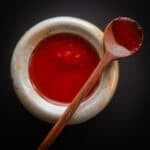
Fermented Maple Hot Sauce
A simple sriracha-inspired hot sauce made from fermented peppers and maple syrup. Makes about 3 cups
Servings: 30 Servings
Calories: 21kcal
Cost: 5
Equipment
- 1 gallon vacuum bag and sealer or a 1 qt mason jar-narrow mouth
- 1 Blender like a Vitamix
- 1 3 quart sauce pot ideally stainless steel
- 1 Spice grinder or mortar and pestle
Ingredients
- 1 lb red fresno peppers or other hot peppers
- ½ tsp Kosher salt 1 % of the peppers weight, plus more to taste
- ½ cup maple syrup
- ¼ cup rice wine vinegar
- ¼ cup water
- ½ tsp cumin seed lightly toasted
- 2 large garlic cloves trimmed and sliced
Instructions
Fermentation
- Remove the stems from the peppers and most of the seeds.
Vacuum Sealed Method
- Toss with the salt and garlic and vacuum seal. Allow the mixture to ferment at room temperature for two weeks.
- I like to ferment the peppers in a warm room where I have a dehydrator going in the summer which helps speed up the process.
Glass Jar Method
- Grind the peppers to a paste in a food processor with the garlic.
- Transfer the pepper paste to a jar, add the salt and water, stir, screw on a lid and allow to ferment for two weeks.
Cooking and Finishing the Sauce
- Toast the cumin seed and grind to a powder.
- Pour the fermented pepper-garlic mixture into a non-reactive pan, adding the water, vinegar, cumin and maple syrup.
- If you use the ground pepper method you will skip adding the water as it was added prior to fermentation.
- Bring the pot to a boil, turn off the heat, then carefully puree the mixture in a blender until smooth-ish.
- Pureeing hot sauces can be dangerous as it causes pressure to build in the blender. Make sure there's a way for air to escape through the lid before pureeing so the top doesn't blow off.
- Taste the sauce and adjust the seasoning for salt. I usually add an additional ½ teaspoon or so.
- Transfer the sauce to a jar, cool, and store in the fridge. If it was fermented for the full two weeks it will last a long time. It can likely be water-bath canned but I haven't tried it yet.
Video
Notes
- Maple syrup is my first choice for sweetening this sauce, but honey will work fine too. Maple sugar works too, but is more expensive than syrup.
- This can be a good recipe for dark maple syrup or syrup of lower quality as it's used as a sweetener instead of all by itself.
- To speed up fermentation, you can add a few scrapes of fresh ginger, or a piece of sauerkraut.
Nutrition
Calories: 21kcal | Carbohydrates: 5g | Protein: 0.3g | Fat: 0.1g | Saturated Fat: 0.01g | Polyunsaturated Fat: 0.04g | Monounsaturated Fat: 0.004g | Sodium: 41mg | Potassium: 61mg | Fiber: 0.2g | Sugar: 4g | Vitamin A: 144IU | Vitamin C: 22mg | Calcium: 8mg | Iron: 0.2mg